
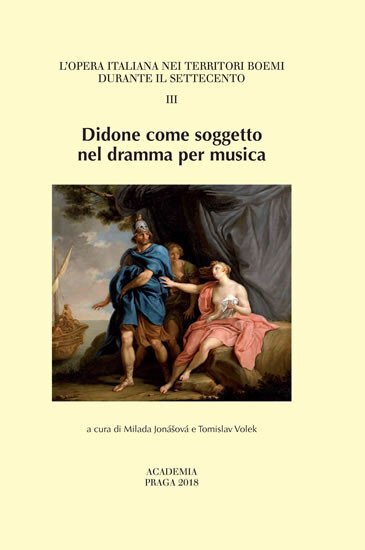
Didone come soggetto nel dramma per musica
Authors
| ISBN | 978-80-200-2925-6 |
|---|---|
| EAN | 9788020029256 |
| Publisher | Academia |
| Year of publication | 2019 |
| Number of pages | 314 |
| Binding | Hardcover |
| Dimensions | 236 x 163 x 24 mm |
| Weight | 644 g |
| Language | Italian |
Book locations
The volume contains papers from the third conference in the series devoted to Italian opera in Bohemia in the eighteenth century, organized by the Cabinet of Music History of the Institute of Ethnology of the Czech Academy of Sciences, the Centre for Baroque Culture in Český Krumlov, and the Mozart Society. The conference was held in connection with the modern premiere of a Prague opera by Antonio Boroni (1738?–1792) from 1768, based on the subject of the Carthaginian queen Dido. Entitled Didone as an Operatic Inspiration, the conference took place on 16–17 September 2017 in Český Krumlov. The meeting was opened by Reinhard Strohm (Universities of Oxford and Vienna) with a paper on rituals and their secularized forms in operatic scenes. Manfred Hermann Schmid (Universities of Tübingen and Munich) compared musical settings of Dido’s final suicide scene in various eighteenth-century operas. Andrea Chegai (Sapienza University of Rome) analysed nuances in the differing portrayals of the Carthaginian queen’s personality in Italian operatic works from 1726 to 1749, while Antonella D’Ovidio (University of Florence) focused on Niccolò Jommelli’s musical setting of Didone. Tomislav Volek examined the tension between the aesthetic norms of the operatic genre dramma per musica and the requirement of a happy ending (lieto fine) imposed on the musical setting of the story. Milada Jonášová reported on Boroni’s Didone, with particular attention to the aria “Ah non lasciarmi,” comparing Boroni’s setting with those by Mozart, Guglielmi, and Perez. Wolfgang Hochstein (Hochschule für Musik und Theater Hamburg) discussed Dido in two settings by Johann Adolf Hasse, while theatre historian Andrea Sommer-Mathis (Austrian Academy of Sciences, Vienna) presented documentary evidence concerning the performance of the intermezzo musicale La fuga d’Enea (1729) at Vienna’s Kärntnertortheater.
Related

![Obálka ke stažení [image/jpeg, 2.2 MB]](https://www.academiaknihy.cz/attachment/1560.39dea4c2cb/Didone_come.jpg)